
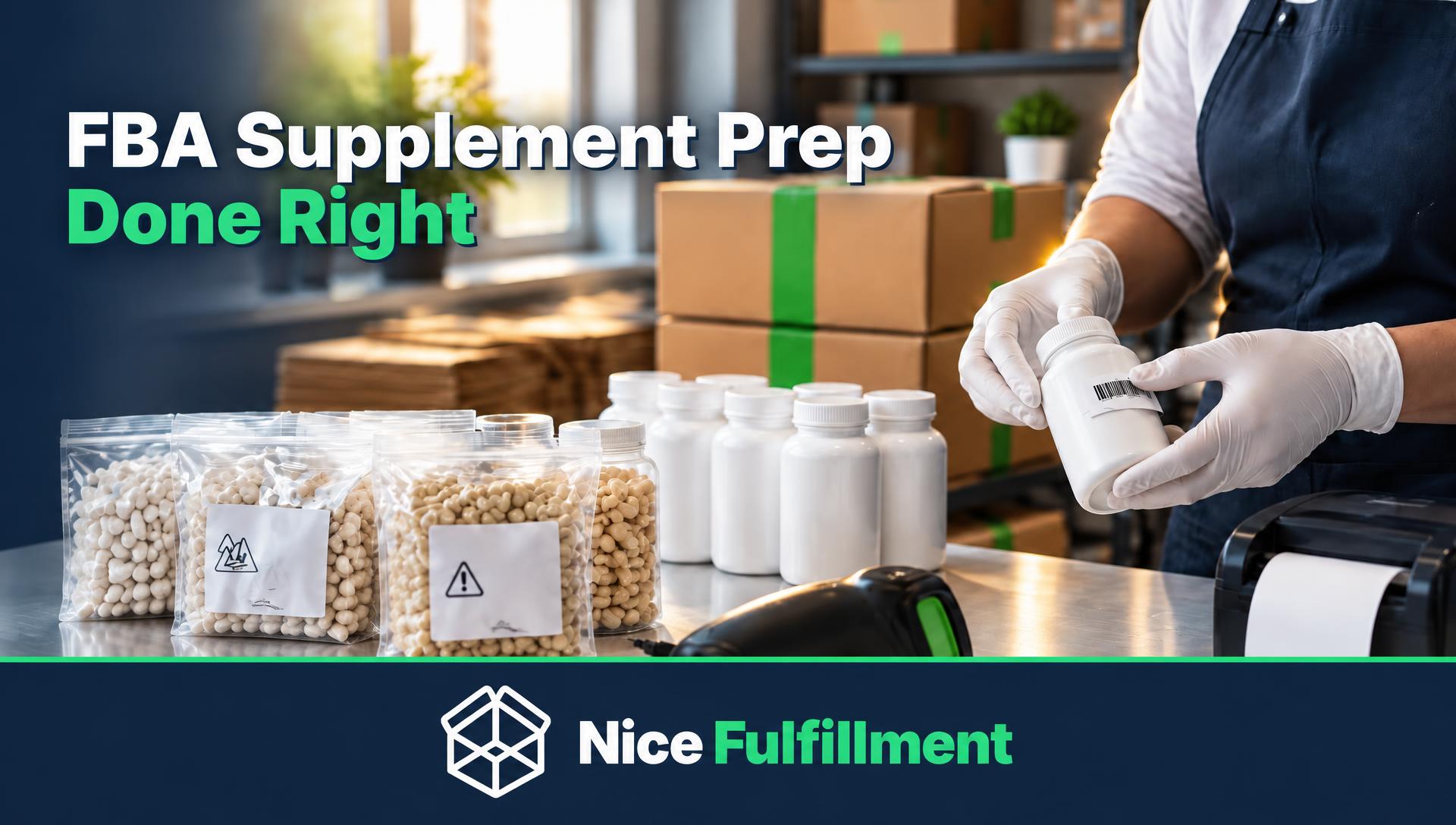
Selling vitamins and supplements through Amazon FBA can unlock massive reach, but it also comes with stricter prep and compliance requirements than most product categories. Unlike apparel or standard consumer goods, supplements are ingestible, expiration-dated, and often sensitive to heat, moisture, and breakage. That means Amazon applies additional packaging, labeling, and safety standards before your inventory is accepted into fulfillment centers.
As of January 1, 2026, Amazon is no longer handling FBA prep work for sellers the way it once did. Brands are now fully responsible for making sure their products arrive fully prepped and compliant. If they don't, shipments can be delayed, relabeled with fees, rejected at intake, or even disposed of.
Below, we'll cover:
- · Questions to ask about your supplement inventory before FBA prep
- · How to bag, tag, and box vitamin and supplement products for FBA compliance
- · Special handling for fragile, leak-risk, meltable, and expiration-dated goods
- · Amazon FBA barcode rules and the 2026 labeling changes
- · What happens if you miss FBA prep or compliance requirements
- · Helpful Amazon policy references and prep resources
Phase 1: The Pre-Prep Assessment (Ask Yourself These 5 Questions)
Before beginning prep, evaluate your supplement products and packaging. Your answers determine which Amazon prep rules apply and what protective steps you'll need.
1. Is my supplement considered a "Small Product" by Amazon?
Amazon fulfillment centers rely heavily on conveyor belts, totes, and automated scanners. Very small supplement bottles or sample packs can fall through gaps or fail to scan properly.
The Rule: If the longest side of your final packaged unit measures less than 2-1/8 inches, Amazon classifies it as a Small Product. (Think the size of a credit card.)
What to do: Increase the package surface area by placing the unit inside a poly bag or outer box that exceeds the minimum size so it can be safely scanned and conveyed.
2. Is my product ingestible and required to have tamper-evident sealing?
All vitamins and supplements are ingestible products, which places them in a higher safety category.
The Rule: All ingestible products must have tamper-evident packaging such as induction seals, foil liners, or shrink bands. Amazon is very strict on this.
What to do: Confirm every unit is factory sealed. Do not send loose-cap or unsealed supplement containers to Amazon FBA — they will be destroyed.
3. Do my supplement products have an expiration date or shelf life?
Amazon considers a product to be "expiration-dated" if it has a shelf life or loses effectiveness over time, even if a specific date is not printed on the packaging.
The Rule: At the time of check-in, products sent to Amazon must have expiration dates clearly printed on each unit and have a remaining shelf life long enough to allow products to be consumed in full plus an additional 90 days.
What to do: Make sure expiration dates are visible, not covered by labels, and aligned with your listing data. Ensure the remaining shelf life exceeds Amazon's minimum requirement at the time of check-in.
4. Could my products leak, melt, or spill during transit, and is the packaging fragile?
Liquid vitamins and tinctures, oils, softgels, and gummies are the usual suspects here. Powders (protein, collagen, electrolyte mixes) can turn into a glitter bomb if a lid pops or a pouch tears. And if your products are contained in glass, a bad drop can ruin the day.
The Rule: Amazon has different prep requirements depending on the risk type: liquids (leakable), powders and granules (spillable), gummies and meltables (heat-sensitive), and fragile packaging (breakable). In general, anything with leak, spill, melt, or break risks need extra containment and protective packaging to prevent product damage and protect other inventory. For meltable inventory, there are seasonal restrictions dictating when those products can be stored and sold.
What to do: Take stock of each SKU and flag any that contain one or more of the risk types listed. Then comb through the packaging requirements and special handling sections in this article for full details on how to prep each.
5. Am I selling supplements as a bundle or multi-pack?
Supplement kits and variety packs are common but must follow Amazon's set-pack rules. If multiple components arrive loose in a shipping carton, Amazon may receive them as individual items.
The Rule: Multi-unit sets must be physically bundled and clearly labeled as one sellable unit before arriving at an Amazon facility.
What to do: Combine all components of the set into one single package (bag, box, or shrink-wrap) and apply a visible label that states it's sold as a set.
Phase 2: Amazon Secure Packaging Requirements for Supplement Products
Once you've assessed your supplement SKUs, the next step is executing compliant physical prep. This phase covers the must-follow Amazon FBA packaging rules that apply to many supplement products entering Amazon's fulfillment warehouse.
Minimum Packaging Size Requirements
Supplement products are often sold in small bottles or pouches. Units that are too small are at higher risk of being lost or mis-scanned inside automated systems.
If your packaged supplement bottle, tincture, or pouch measures under 2-⅛ inches on its longest side, the item must be overboxed or bagged to increase its surface area so it can move safely through conveyor and scanning systems.
Note: if you have to overbox or overbag your products to meet Amazon size and product safety requirements, your barcode needs to be placed on the outermost packaging so it stays visible and scannable.
Double Sealing Requirements
Amazon requires supplement packaging to be secure, non-porous, and resistant to leakage or contamination. To meet this standard, all supplement products must have a double seal — a secure primary closure plus a secondary safety seal.
The container must have a lid that cannot easily open during handling, along with at least one approved secondary seal, such as:
- · Safety ring
- · Induction seal
- · Shrink wrap band
- · Child-resistant cap with inner seal
If the manufacturer packaging does not include a secondary seal, sellers must add one — such as a tamper tape seal around the cap or placing the entire container inside a sealed poly bag — to prevent leakage and tampering during fulfillment.
Sold-As-Set Requirements
If you're selling bundles or sets of your vitamins and supplements on Amazon, their FBA fulfillment centers must receive, store, and ship them as one single unit. If components arrive loose or in separate packaging, the warehouse will treat them as individual items.
Make sure to:
- · Secure everything together: All components must be combined into a single package, like one larger polybag, a single rigid box, or a heat-sealed shrink wrap.
- · Apply a "Sold as Set" sticker: Once packaged, Amazon requires you to apply a label to the outside of the package that clearly states: "Sold as set," "Ready to ship," or "This is a set. Do not separate."
- · Check your barcodes: Only the set's unique barcode (ASIN or FNSKU) should be visible on the outside. Cover or face inward any barcodes on individual components so the scanner can only read the barcode for the complete set.
Fragile Container Requirements
Supplements packaged in glass or ceramic (bottles, tinctures, jars) need fragile-safe prep to help them survive shipping and keep Amazon workers safe.
Per Amazon FBA standards, fragile containers must be fully protected and not exposed — either secured with bubble wrap or overboxed in a solid, six-sided box. If the product is liquid or cream in a glass container, it must be bubble wrapped even if you also use an overbox.
Amazon recommends running packaged units through a 3-foot drop test onto a hard surface at least five times (flat on top, bottom, longest side, shortest side, and on a corner) to ensure no damage occurs.
Poly Bag Specs & Suffocation Warning Requirements
If you're using poly bags to contain or protect supplement products, Amazon has very specific requirements:
- · Minimum thickness: 1.5 mil.
- · Suffocation Warning: A suffocation warning is required if the bag opening measures 5 inches or more when laid flat.
The warning must be printed in a legible font size appropriate for the bag size. At least a 10-point font must be used for bags with a total length + width under 29 inches.
Phase 3: Additional Special Handling Requirements for Supplement Products
Beyond standard packaging, Amazon FBA places a few extra handling requirements on supplement products because they're ingestible and often use higher-risk container types (glass, liquids, powders, bundles).
Expiration-Dated Inventory Requirements
Supplements are typically expiration-dated, which makes date visibility and shelf-life quality non-negotiable for Amazon FBA.
Amazon treats expiration-dated inventory like a controlled product category: it actively tracks and audits dates to keep shipments compliant, protect customer safety, and ensure it can execute a recall fast if one ever happens.
Amazon requires the following expiration labeling for consumable products like supplements:
- · All individual units must have expiration dates in MM-DD-YYYY or MM-YYYY format.
- · Expiration dates must be included on both the individual unit and the outer box in 36-point or larger font.
- · For items bubble wrapped, poly-bagged, or case packed, expiration date labels must be applied to the outermost layer as well.
- · Best-by or sell-by dates are considered equivalent to expiration dates. Manufacturing dates are treated as production dates and must be clearly labeled if used in conjunction with expiration dates.
Amazon also sets a minimum shelf-life requirement to allow sufficient time for vitamins and supplements to be consumed in full.
Shelf-life requirement: Time for product to be consumed in full + an additional 90 days before expiration. For example, if a bottle of supplements has 30 daily servings, the expiration date cannot be less than 120 days away when received by Amazon.
Amazon recommends that herbal or mineral supplement products have at least 730 days of shelf life left when sent to their facility to account for long sell-through timelines.
Meltable Inventory Restrictions
One of the strictest requirements vitamin and supplement brands may face is around what Amazon classifies as "Meltable" products — heat-sensitive products that can melt at 155°F. Vitamin gummies and softgel capsules often get lumped into this category.
- · Seasonal Restrictions: Amazon only accepts and sells meltable inventory from October 6 to April 15 each year.
- · Removal and Disposal: Any meltable inventory remaining in fulfillment centers after April 15 will be marked as unfulfillable and may be disposed of. To avoid this, sellers must submit removal orders before April 15 and can request units be shipped back to them.
- · Potential Exceptions: If you believe your gummies or softgel products can survive high heat, you must submit specific documentation proving so from your manufacturer and request a review from Amazon Seller Partner Support.
Phase 4: Choosing the Right Barcode (and the 2026 Rule Change)
Amazon allows two barcode types: Manufacturer Barcodes (UPC/EAN) and Amazon Barcodes (FNSKU). Which one you're allowed to use depends on whether you're a reseller or a brand-registered seller — and that distinction becomes mandatory on March 31, 2026.
- · Resellers: Starting March 31, 2026, you must use Amazon Barcodes (FNSKU) for all products. Even if the supplement already has a manufacturer's UPC on it, you'll be required to cover it with an Amazon barcode sticker to keep your inventory attributed to you and not commingled with other sellers' stock.
- · Brand owners/representatives: If you're enrolled in Amazon Brand Registry as a brand representative, you may continue to use the Manufacturer Barcode (UPC) without adding extra stickers, provided the product has a valid GS1 standard UPC.
- · Private label or hand-made items: Using an Amazon FNSKU barcode is highly recommended for private-label sellers to ensure brand exclusivity, prevent commingling with counterfeits, and improve inventory tracking.
Printing and Placing Barcodes Correctly
Since vitamin and supplement packaging often comes in cylindrical bottles, jars, or small boxes, label quality and placement is particularly important to get right.
Printing: Amazon recommends using a thermal or laser printer since inkjet printers are prone to smudging. Labels must be white and non-reflective, with dimensions between 1 × 2 inches and 2 × 3 inches, and printed at a minimum resolution of 300 DPI to remain readable through the fulfillment process.
Placement: Barcode labels must go on the outside of the final, outermost protective layer — whether that's a poly bag, box, or bubble-wrapped unit. The labels must sit on a flat, even surface, not over a curve or fold. Even a correctly printed barcode can fail to scan if it's applied to uneven surfaces.
Penalties for Missing Prep Requirements
Skipping prep might feel like a shortcut, but Amazon has very little tolerance for non-compliant inventory — especially in categories like vitamins and supplements. If your products arrive without meeting the safety, packaging, sealing, or labeling standards outlined above, the consequences can escalate quickly.
At best, Amazon may correct the issue for you and charge per-unit fees, including preparation defect fees, unplanned-labeling fees, or inbound defect fees for improperly labeled, sealed, or packaged supplement shipments.
At worst, non-compliant shipments can be refused at the dock, returned to you at your expense, or flagged as seller-damaged — leaving you responsible for return freight and lost inventory. Items that pose a safety or compliance risk, such as ingestible products without proper seals, expiration dates, or compliant ingredient labeling, may be disposed of immediately and are typically not eligible for reimbursement.
Repeated issues don't just affect a single shipment. Ongoing non-compliance can lead Amazon to mandate additional prep requirements, block future inbound shipments, or, in severe cases involving safety or regulatory violations, deactivate your selling account entirely.
If This Feels Overwhelming, You're Not Wrong
Amazon's vitamins and supplements prep requirements are detailed for a reason, but that doesn't make them easy. Between seal and safety rules, expiration and lot tracking, strict labeling standards, and the shift away from Amazon-handled prep starting January 1, 2026, getting it wrong can cost you far more than just time. It can mean refused shipments, disposed inventory, added fees, and compliance risk tied directly to ingestible products.
It's also fair to hesitate. Many brands previously relied on Amazon as a backstop, and now that responsibility sits squarely with the seller. Managing supplement prep in-house — from compliant labeling and barcode placement to tamper seals and date checks — can quickly pull your team away from the work that actually grows your brand.
That's where dedicated prep support can help. Full-service 3PLs like Nice Fulfillment build vitamins and supplements-specific prep directly into fulfillment — handling packaging, labeling, compliance checks, and expiration controls before inventory ever reaches Amazon. They can also help reduce downtime risk by enabling FBM triggers when FBA stock runs low.
If you're weighing whether to keep supplement prep internal or hand it off to a partner who manages these requirements every day, it may help to talk through your setup. Reach out to see if Nice Fulfillment could be a good fit, or simply to get clarity on your next move.