
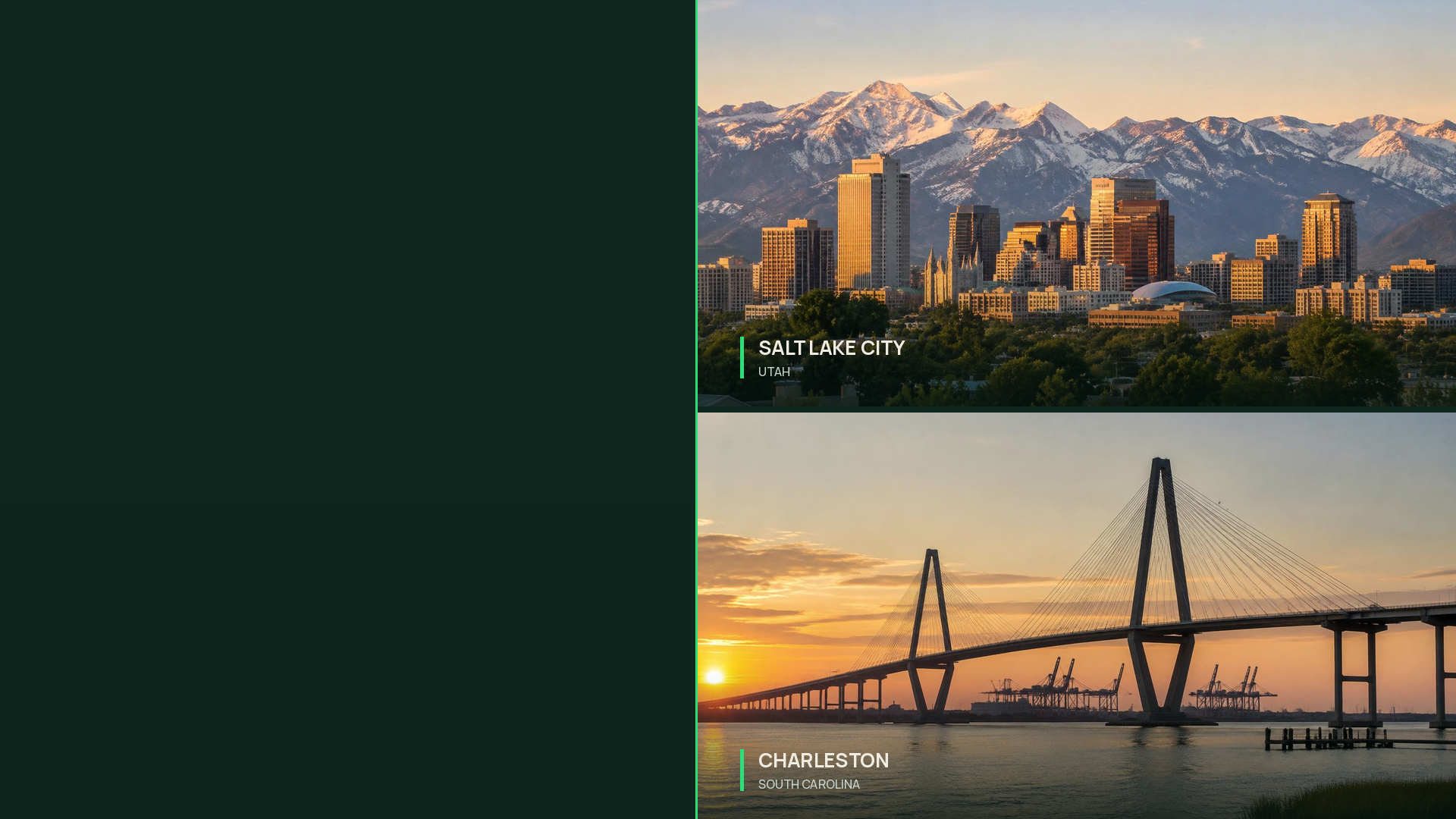
Fulfillment Network
Charleston + Salt Lake Citymoves most of the U.S. inside a 2-day zone.
Charleston ships to most of the eastern half of the U.S. in two days from the port. Salt Lake City hits most of the western half in two days from a single inland hub. The two together cover an outsized share of the country without leaning on a third warehouse.
BySophie HilbournContent Lead, Nice Fulfillment
Quick answer
Ground shipping is priced by zone, and the zone is set by the distance between where a package starts and where it ends up. Two well-placed warehouses — one on the East Coast, one in the Mountain West — keep the bulk of a nationwide brand's orders in the lower zones, which lowers shipping cost and shortens transit time across the country.
Your shipping invoices probably have a pattern by now. Orders going to customers near your warehouse are cheap and arrive fast. Orders going to the other side of the country cost more, take longer and generate most of your "where's my package?" emails. And as your brand grows, more of your customers seem to live far from your warehouse.
The fix with the biggest payoff is usually moving inventory closer to the people buying it. Carriers price and schedule ground parcels by distance, so where your inventory sits shapes your shipping cost and delivery time more than almost any rate you can negotiate.
That's the logic behind Nice Fulfillment's network: one fulfillment center in Charleston, South Carolina, and one in Salt Lake City, Utah. In this article, we're sharing:
- Why warehouse location drives shipping cost
- Why Charleston anchors our East Coast coverage
- Why Salt Lake City covers the West Coast
- How orders get routed between two nodes
- What this means for your delivery promise
Why does warehouse location drive shipping cost more than carrier rates?
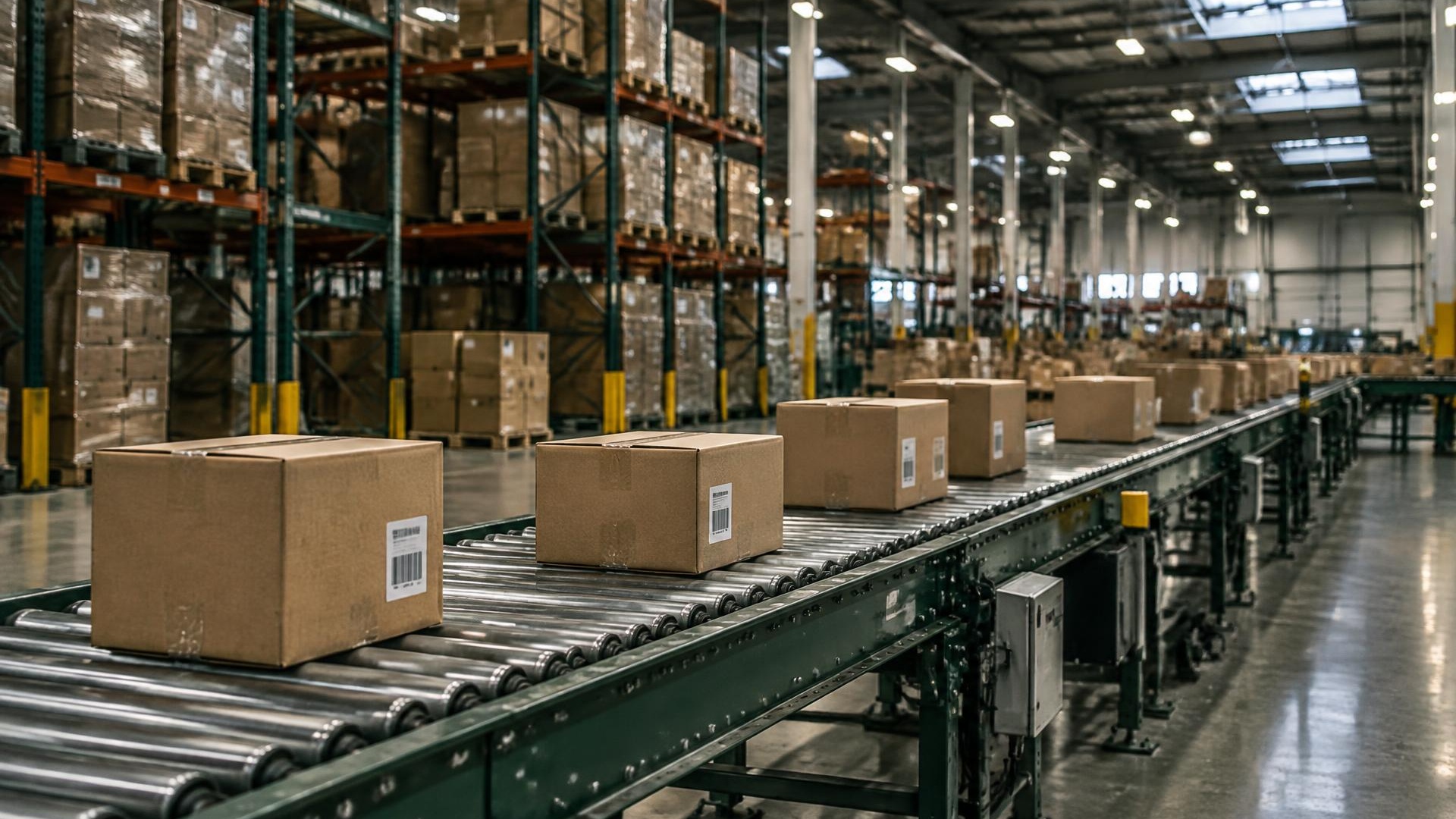
Ground shipping is priced by shipping zone, and the zone is set by the distance between where a package starts and where it ends up.
A shipping zone is a distance band between the origin ZIP code and the destination ZIP code. For ground parcels in the contiguous U.S., the major carriers use zones numbered 2 through 8, with zone 2 the closest and zone 8 the farthest. Each step up in zone raises the base rate, and longer distances usually add transit days. A ground package crossing the full width of the country can spend close to a business week in transit.
Zone map · Charleston / Salt Lake City → U.S. destinations
Distance band per origin / destination pair. Bands shown are typical; exact zone assignments depend on the carrier and ZIP pair.
| Origin | Destination | Distance band | Note | Zone |
|---|---|---|---|---|
| Charleston, SC | Atlanta, GA | ~3 hr · Zone 3 | Southeast short-haul | Zone 3 · near region |
| Charleston, SC | Boston, MA | ~1 day · Zone 5 | Northeast corridor | Zone 5 · half-country |
| Charleston, SC | Denver, CO | ~2 days · Zone 7 | Mountain West (cross-country) | Zone 7 · cross-country |
| Charleston, SC | Los Angeles, CA | ~3 days · Zone 8 | West Coast farthest | Zone 8 · farthest |
| Salt Lake City, UT | Los Angeles, CA | ~1 day · Zone 5 | West Coast short-haul | Zone 5 · half-country |
| Salt Lake City, UT | Boise, ID | ~8 hr · Zone 4 | Mountain short-haul | Zone 4 · mid distance |
| Salt Lake City, UT | Phoenix, AZ | ~9 hr · Zone 4 | Southwest short-haul | Zone 4 · mid distance |
| Salt Lake City, UT | Atlanta, GA | ~2 days · Zone 7 | East Coast farthest | Zone 7 · cross-country |
This is where a lot of brands get stuck. They put real effort into negotiating carrier discounts while most of their orders still ship into zones 6 through 8. A discount on a zone 8 rate still leaves you paying a zone 8 rate.
Why two warehouses? One central building still leaves both coasts in high zones. Five or six can spread inventory thin enough to make stockouts harder to manage for a growing brand. Two nodes placed well can cover a large share of the population in low zones without that tradeoff. The question becomes where to put them.
Why Charleston anchors our East Coast coverage
Charleston gives us short trips to the most densely populated part of the country, plus a major port for brands that import their inventory.
Population reach
A large share of Americans live in the eastern half of the country, in the Northeast corridor, the Southeast and the eastern Midwest. A warehouse on the Southeast coast puts those customers in lower zones than one placed in the middle of the country. Interstate access via I-26 to I-95 gives carriers a direct line up and down the coast.
Port access
The Port of Charleston is one of the busiest container ports on the East Coast. For brands bringing in product from overseas, that matters. A container can land in Charleston, get drayed about 5 miles to our warehouse, be received, and be ready to ship East Coast orders without first crossing the country on a truck.
A common mistake is receiving all imports through a West Coast port and trucking inventory east. Brands pay to move product across the country as freight, then often pay again when parcels ship back west as zone 7 and 8 orders. An East Coast port skips the first trip. With imports and the East Coast covered, the West needs its own anchor.
Why Salt Lake City beats a coastal warehouse for the West
Salt Lake City sits near the center of the Western U.S., so it reaches the Mountain states and much of the Southwest in fewer zones than a warehouse on the Pacific, while keeping the West Coast within reach.
Most brands hear "West Coast fulfillment" and picture Southern California. A warehouse there is close to California customers but far from Denver, Boise, Montana and the Dakotas. From Salt Lake City, orders reach California, Arizona and Colorado, and the Mountain states stay in low zones instead of becoming the long-haul exception. I-15 and I-80 cross in Salt Lake City, giving carriers direct routes north, south, east and west.
The tradeoff is that some California addresses may land a zone higher than they would from Los Angeles. For brands with customers spread across the West, the gain in the interior usually outweighs that difference. With both nodes in place, what matters is how each order finds the right one.
How are orders routed between two fulfillment centers?
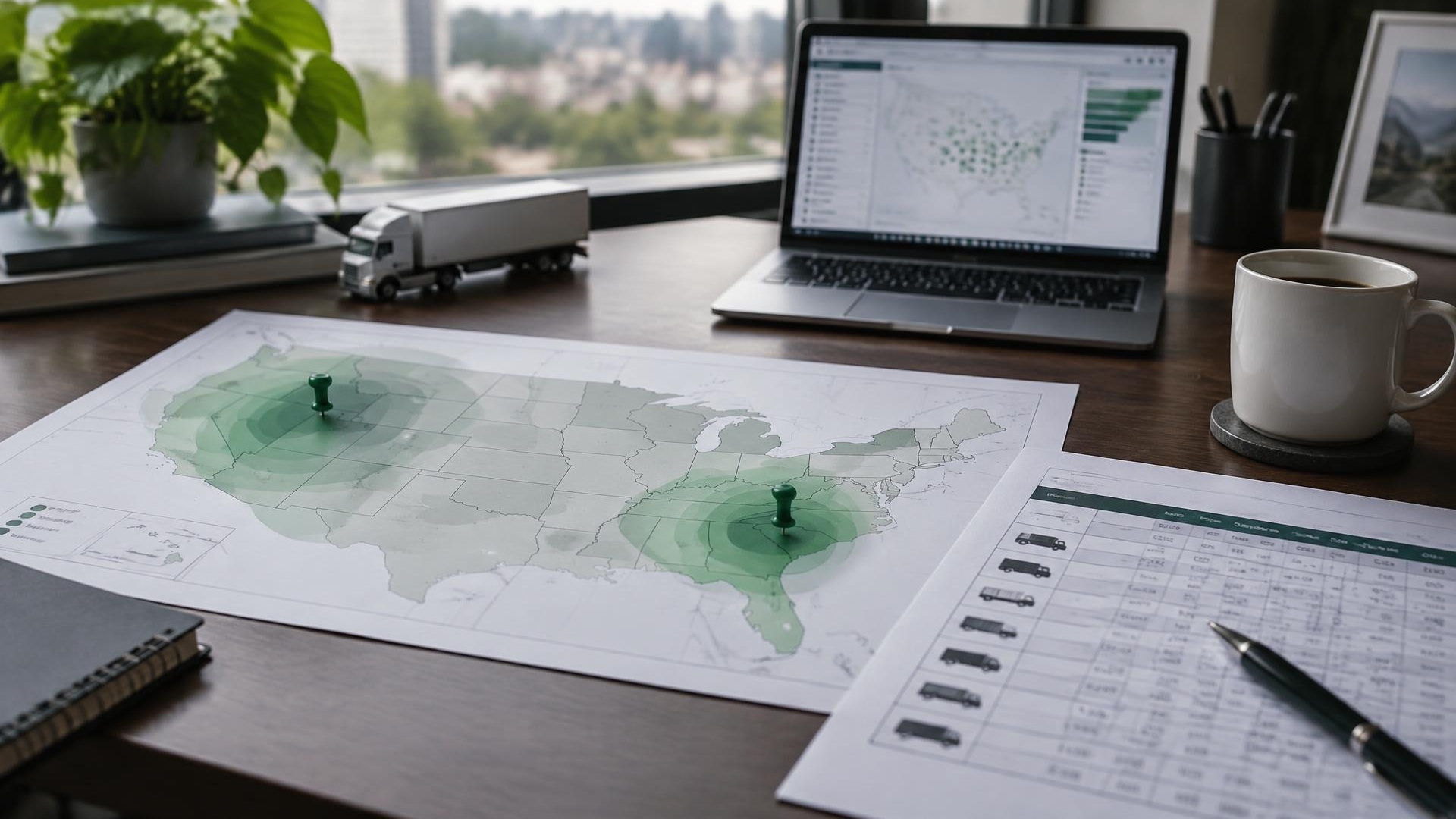
Each order ships from the node closest to the customer by default, and from the other node if the closer one is out of stock. Here's how that plays out:
Order arrives from your store
It flows from Shopify, Amazon, TikTok Shop, or another connected channel into our warehouse management system in real time.
System checks both warehouses
Compares the destination address against both nodes and picks the one closer to the customer by ZIP distance.
Inventory is verified at the chosen node
If every item is in stock there, the order is picked, packed, and shipped from that building without ever hitting the other node.
Fallback if the closer node is short
If the chosen node is out of an item, the order routes to the other warehouse so it still ships in one box. Customers in the middle of the country (Texas, parts of the Midwest) are served from whichever node the ZIP places closer.
Customers in the middle of the country, such as Texas and parts of the Midwest, fall in the overlap and can be served from either building depending on the address.
Routing is the easy part. Inventory placement is where it goes wrong. Split stock 50/50 when most of your customers are in the East, and Charleston runs out first. Fallback becomes the default, and East Coast orders ship cross-country from Salt Lake City. Splitting and replenishing inventory based on where orders go keeps routing working as designed.
When routing and inventory line up, the result shows up in the number your customers notice most: how long they wait.
What does a two-node network mean for your delivery promise?
Two well-placed nodes give you a shorter and more consistent delivery window across the whole country, which makes it easier to promise a delivery date and keep it.
Network at a glance · illustrative averages
2 days 17 hrs
Network-wide average order transit time, place-to-delivered
99.7%
DTC orders shipped on time across the Charleston + Salt Lake City network
94%
Orders shipping into zones 2–4 across the two-node network
Much of that comes from cutting the long tail. When fewer orders ship into zones 7 and 8, fewer packages take five or more days, and the gap between your fastest and slowest deliveries narrows. Customers on opposite coasts tend to see more similar delivery times.
That consistency shows up in a few places:
- Checkout: A tighter window lets you show a confident delivery estimate.
- Support: Fewer slow outliers mean fewer "where's my order?" tickets.
- Repeat purchases: Customers who get orders when expected are more likely to order again.
One caution: an average is an average. If you promise two-day delivery at checkout based on a 2-day, 17-hour average, some orders will miss. Set the promise based on the window your slowest common zones can reliably hit, and let faster deliveries be a pleasant surprise.
"Most brands don't need a warehouse in every region. They need two in the right places. Charleston puts us close to the East Coast and the port, and Salt Lake City gets us into the West and the Mountain states without the long-haul zones."
Your customer map should decide where your inventory lives
Everything in this article comes back to one idea: distance sets your shipping cost and your delivery speed, and you control distance by deciding where inventory sits. For a brand shipping nationwide, two well-placed warehouses will do more for your shipping costs than any carrier discount applied to cross-country orders.
The hard part is the analysis behind it: knowing where your customers are, which zones you're paying for today, and how to split inventory so routing doesn't fall back to the far warehouse. That's the work we do at Nice Fulfillment with our Charleston and Salt Lake City network.
Map your customers against our network
Send us a recent sample of your order data and we'll run a free zone analysis showing which zones you ship into today and how those orders would ship from Charleston and Salt Lake City.
We look at destination ZIP codes, weights, and dimensions, then model what your shipping cost, transit time, and zone mix would look like against our two-node network. No commitment, no contract window.
Frequently asked questions
The questions below come up most often in our zone-analysis conversations with brands evaluating fulfillment networks.
1.Do I need two warehouses if most of my customers are on one coast?
Not always. If the large majority of your orders go to one region, a single warehouse near those customers may cover you well. A second node tends to pay off once a meaningful share of orders ships into high zones from your current location. A zone analysis of your order history shows where that line falls for your brand.
2.Does splitting inventory between two warehouses cost more?
It can add some cost, since inventory is received and stored in two places and needs to be rebalanced over time. For most brands shipping nationwide, the savings from lower zones and shorter transit times outweigh those costs, but the math depends on order volume, SKU count and where customers are concentrated.
3.Can I ship imported inventory directly to the Charleston warehouse?
Yes. Brands importing through the Port of Charleston can have containers delivered to our Charleston facility for receiving. This keeps East-bound inventory from crossing the country before it ships to customers.
4.Will customers get split shipments from two warehouses?
Usually not. If the closer warehouse is missing an item, the whole order typically routes to the other warehouse so it ships in one box. A split only happens when neither warehouse has every item on hand, and keeping inventory balanced between the two makes that rare.
5.Do Charleston and Salt Lake City cover Alaska and Hawaii?
Both locations can ship to Alaska and Hawaii, but transit times and costs are higher than for the continental U.S. because those shipments travel by air or ocean for at least part of the trip.
6.How should I compare coverage maps between 3PLs?
Check what the map measures. A map shaded by land area can look impressive across Wyoming and Nevada while saying little about where your customers live. Coverage measured by population tells you what share of your likely orders arrive in a given number of days, which is the number that affects your shipping costs and delivery times.
7.What data do I need for a free zone analysis?
Usually a recent export of orders with destination ZIP codes, plus package weights or dimensions if you have them. From that, we can map which zones your orders ship into today and how they would ship from our network.
About the author
Sophie Hilbourn
Content Lead, Nice Fulfillment
Sophie leads content for Nice Fulfillment, writing about the operational details of running DTC fulfillment — from zone math and inventory placement to peak-season labor and shipping economics. She works closely with our account managers and warehouse leads to keep what we publish honest about how fulfillment actually runs.
Further reading
Looking to map your customers against our network? See what Charleston + Salt Lake City costs for your brand →
Want a quick read on staffing before the orders hit? 3PL Peak Season Staffing: questions to ask before BFCM →
Curious about where inventory should actually sit going into BFCM? Black Friday inventory allocation for multiple warehouses →